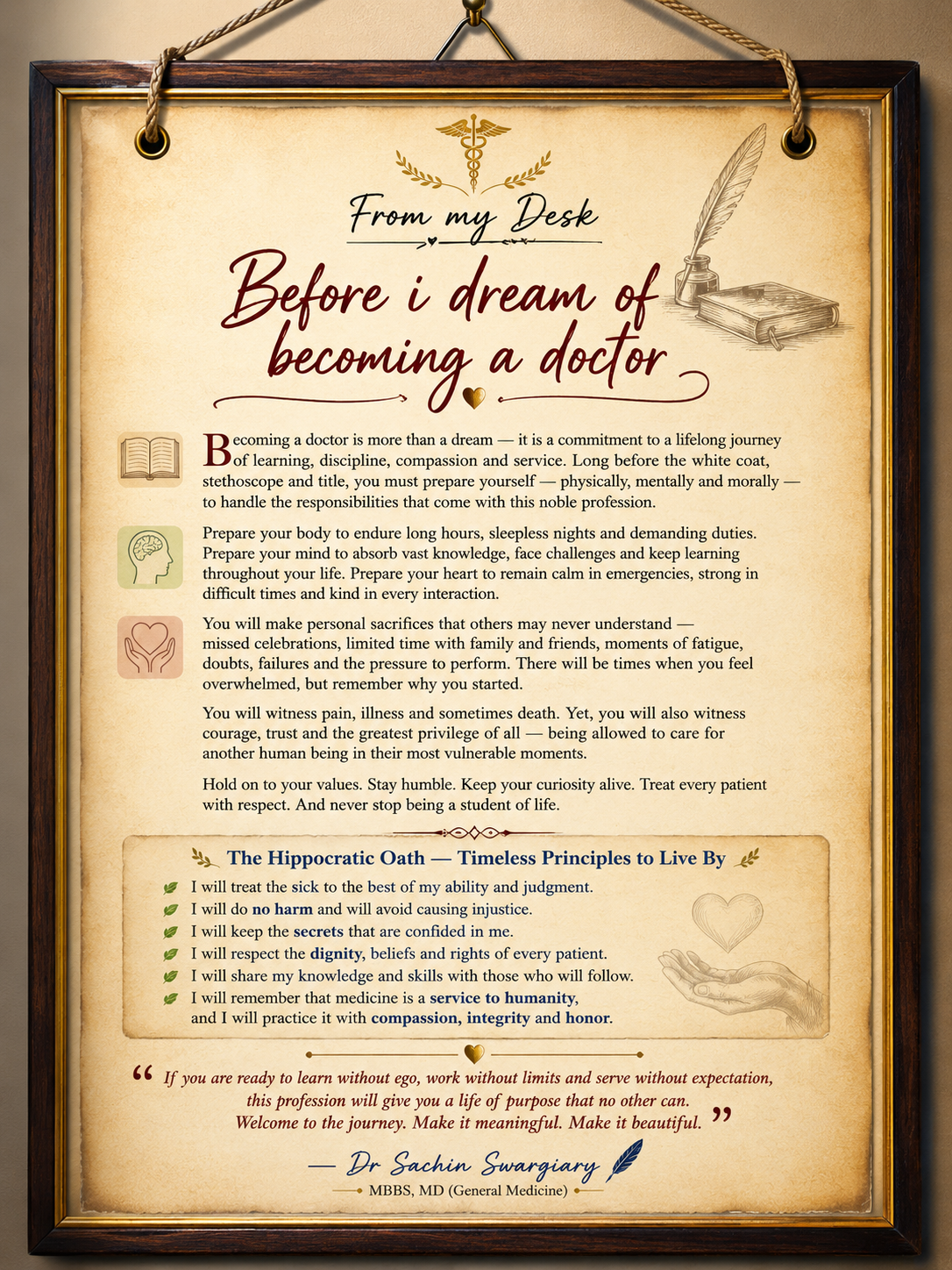
From My Desk
Before I dream of becoming a doctor, I must first understand what I am asking of myself. The white coat may look simple from a distance, but it carries years of learning, responsibility, discipline and service within its folds. Medicine is not merely a course that ends with an examination, nor a title that begins before a name. It is a lifelong commitment to remain prepared — physically, mentally and morally — for moments when another human being may depend upon my knowledge, my judgment and sometimes simply my presence.
I must be ready to strengthen my body for long hours, busy wards, emergency calls and nights when sleep becomes a luxury. I must strengthen my mind to absorb an enormous body of knowledge, accept correction without losing confidence, face uncertainty without pretending to know everything, and continue learning long after the last university examination is over. There will be days of success, but there will also be difficult cases, mistakes narrowly avoided, disappointing results, fatigue and self-doubt. The profession will repeatedly ask me to become better than I was yesterday.
I must also understand the personal sacrifices that medicine quietly demands. There may be festivals I cannot attend, family occasions I miss, journeys postponed, friendships that receive less time than I wish, and nights when others are resting while I am reading, revising or caring for someone who is ill. These sacrifices should never become a reason for arrogance. They should remind me instead that every privilege in medicine has been earned through responsibility, and that the patient standing before me has also made sacrifices of time, money, hope and trust to seek my help.
Medical school will teach me anatomy, physiology, pathology, pharmacology and the science of disease. Patients will teach me something equally important: humility. They will teach me that illness is never only a laboratory value or an image on a scan. Behind every diagnosis is a person who may be afraid, a family waiting for an answer, and a life temporarily interrupted by disease. I must learn to listen before I speak, examine before I assume, think before I prescribe, and communicate with honesty even when the answer is uncertain.
The Hippocratic tradition is centuries old, yet its spirit remains remarkably modern. It reminds us to use our ability and judgment for the benefit of the sick; to avoid harm and injustice; to respect the confidence placed in us; to preserve the dignity of every patient; and to pass medical knowledge responsibly to those who come after us. These are not ceremonial words meant only for the day of graduation. They are principles to return to on ordinary days — especially when we are tired, hurried or under pressure.
The Hippocratic Oath — Principles to Carry Forward
- I will use my knowledge and judgment for the benefit of the sick.
- I will avoid harm, injustice and exploitation.
- I will respect confidentiality and the trust placed in me.
- I will treat every patient with dignity, compassion and fairness.
- I will continue to learn, and I will share knowledge with those who follow.
- I will remember that medicine is ultimately a service to humanity.
I should know, too, that being strong does not mean becoming emotionless. A good doctor can be scientifically rigorous and still be compassionate. I may witness pain, disability, loss and death, but I will also witness recovery, courage, gratitude and extraordinary resilience. There will be moments when the treatment succeeds because of a precise diagnosis or a timely intervention, and other moments when cure is no longer possible and the greatest service I can offer is comfort, clarity and dignity. Both are part of medicine.
So before I dream of becoming a doctor, I should ask myself a deeper question: am I prepared not only for the achievement, but for the responsibility that follows it? If I am ready to study when no one is watching, to remain calm when others are frightened, to accept that I will never know everything, to keep improving without losing humility, and to place the welfare of the patient above the temptation of ego, then I am beginning to understand this profession.