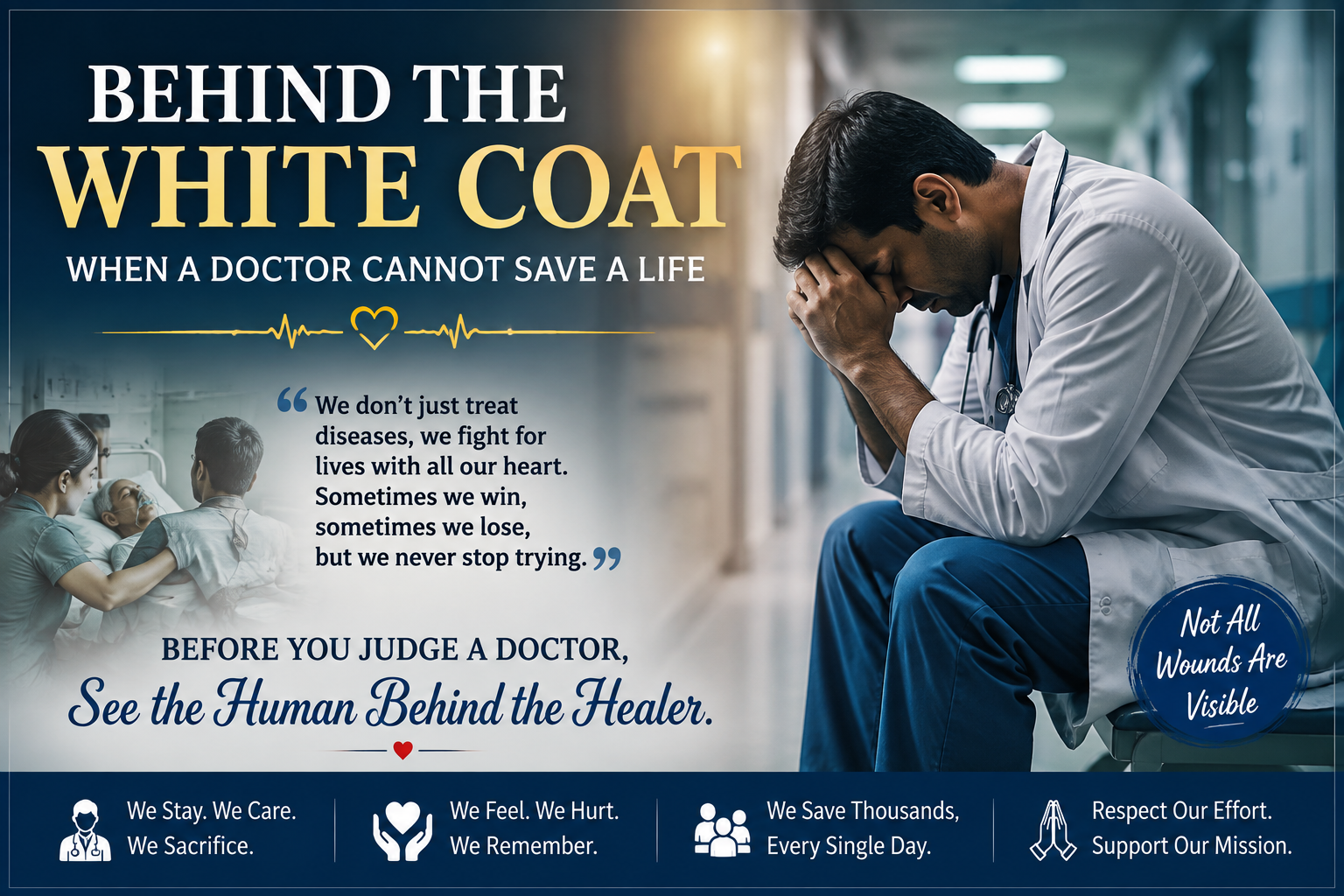
Behind the White Coat: When a Doctor Cannot Save a Life
It was past midnight when an unconscious man was rushed into the emergency department.
His family followed the stretcher, frightened and desperate.
“Doctor, please save him.”
For the family, those few words carried everything—their fear, their hope and their trust.
For the doctor standing beside the patient, they carried something else too: responsibility.
Within moments, the emergency room became busy.
The doctor examined him. Nurses attached monitors. Oxygen was started. Blood samples were sent. Medicines were prepared. Calls were made. Every member of the team had the same goal:
Keep him alive.
The doctor had already been working for many hours. He was tired. He had missed dinner. His family had called earlier, but he could not speak for long.
None of that mattered now.
There was a life in front of him.
And for the next several hours, that life became his priority.
The Battle Begins
The patient's condition continued to deteriorate.
His blood pressure was falling.
His oxygen level was worsening.
His heart was struggling.
The medical team responded again and again—medicines, fluids, oxygen, monitoring, procedures and repeated reassessment.
The doctor explained the seriousness of the situation to the family.
“We are doing everything we can.”
But inside, he was worried.
Doctors learn to recognise when a patient is becoming critically ill. They also learn something much harder:
Knowing what to do does not always mean that medicine can reverse what is happening.
The human body has limits.
So does medical science.
Still, the team continued.
Minutes became hours.
Then suddenly, the monitor changed.
The patient's heart stopped.
Immediately, resuscitation began.
Chest compressions.
Emergency medicines.
Airway support.
Another rhythm check.
Another attempt.
“Continue CPR.”
Everyone kept working.
Nobody wanted to stop.
For the family waiting outside, every passing minute carried hope.
For the team inside, every passing minute was a battle against death.
Eventually, after every reasonable effort had been made, the room became quiet.
The patient could not be revived.
The doctor looked at the monitor for a few seconds.
Then he removed his gloves.
Now came one of the hardest parts of medicine.
He had to walk outside and tell a family that the person they loved was gone.
“But Doctor, You Were Supposed to Save Him”
The family was devastated.
Someone began crying.
Someone stood silently in disbelief.
And then came the question doctors hear more often than people realise:
“Why couldn't you save him?”
Sometimes grief quickly turns into anger.
“Something must have gone wrong.”
“Was treatment delayed?”
“Did the doctor make a mistake?”
These questions are understandable. When someone we love dies, our mind desperately searches for a reason.
But not every death means that someone failed.
And not every poor outcome means that the doctor did not try hard enough.
Sometimes the disease is simply stronger than what medicine can overcome.
The Doctor Walked Back Into the Room
The relatives went home carrying their grief.
The doctor returned to work.
There were other patients waiting.
Another person had chest pain.
Someone else was struggling to breathe.
Another family needed an explanation.
So he continued.
But the patient who had just died did not disappear from his mind.
Later, during a quiet moment, he replayed everything.
Could I have done something differently?
Did I miss anything?
Could another medicine have helped?
Doctors ask themselves these questions even when they have followed the right treatment.
Because doctors are not machines.
They remember patients.
They remember faces.
They remember conversations with families.
And sometimes they carry unsuccessful resuscitations home in silence.
Behind Every White Coat Is a Human Being
A doctor may look calm during an emergency, but calmness does not mean absence of emotion.
Doctors are trained to control their emotions so that they can make decisions when everyone around them is frightened.
They may continue working after witnessing death.
They may move directly from telling one family that their loved one has died to treating another patient who urgently needs them.
They miss meals.
They lose sleep.
They miss family occasions.
They work on festivals, weekends and nights.
They sometimes spend more time beside sick strangers than with their own families.
Most of these sacrifices are never seen by patients.
And doctors rarely talk about them.
They simply return the next day and begin again.
Doctors Are Not Gods
Modern medicine can do extraordinary things.
A stopped heart can sometimes be restarted.
A blocked artery can be opened.
Severe infections can be treated.
Patients can be supported by ventilators when they cannot breathe.
Lives that might once have been lost can now be saved.
But medicine cannot promise immortality.
There are diseases that arrive too late.
There are infections that overwhelm the body.
There are massive heart attacks and devastating strokes.
There are cancers that cannot be cured.
There are patients whose organs have already suffered irreversible damage before reaching the hospital.
And there are moments when even excellent medical care cannot change the final outcome.
A doctor's responsibility is to provide competent, compassionate and timely care—not to guarantee that every patient will survive.
Can Doctors Make Mistakes?
Yes.
Doctors are human, and humans can make mistakes.
Medicine must have accountability. Genuine negligence should be investigated fairly, systems should learn from errors, and patients deserve honesty and safe care.
But there is an important difference between a medical complication, an unavoidable death, an error despite reasonable care, and true negligence.
They should not automatically be treated as the same thing.
An unexpected death should certainly raise questions.
But questions deserve careful answers—not an immediate verdict.
Before accusing someone who spent hours trying to save a life, understand what actually happened.
Listen.
Ask.
Review the facts.
Then judge fairly.
One Outcome Should Not Define an Entire Life of Service
A doctor may treat thousands of patients during a career.
Many recover and return home.
A patient with pneumonia breathes comfortably again.
A person with dangerously high blood sugar improves.
A heart attack is recognised in time.
A critically ill patient walks out of the ICU.
A frightened family receives their loved one back.
Most of these moments quietly disappear into everyday life.
The patient goes home.
The family moves forward.
The doctor sees the next patient.
There may be no headlines and no public applause.
But when one patient dies unexpectedly—or when one unintentional error occurs after years of service—the same doctor can suddenly be remembered only for that single moment.
That should make us think.
One genuine mistake must be acknowledged and learned from, but it should not automatically erase thousands of sincere decisions, sleepless nights and lives helped along the way.
Before You Blame a Doctor
If you ever lose someone in a hospital, your grief is real.
Your anger may also be real.
You have every right to ask what happened.
You have every right to expect explanations, transparency and accountability.
But before concluding that a doctor did not care simply because the patient could not be saved, remember this:
Perhaps that doctor desperately wanted the same outcome you wanted.
Perhaps while you were praying outside the emergency room, the medical team was fighting inside it.
Perhaps the doctor who told you, “We couldn't save him,” had spent the previous hour refusing to give up.
And perhaps, after you left the hospital, that doctor remembered your loved one longer than you would ever know.
A Request From Behind the White Coat
Do not worship doctors.
Do not consider them infallible.
Hold them accountable when accountability is genuinely required.
But also do not expect them to perform miracles that medicine itself cannot promise.
Give doctors something every human being deserves:
Fairness before judgment.
Behind every white coat is a person.
A person who becomes tired.
A person who worries.
A person who sometimes doubts himself.
A person who celebrates quietly when a patient survives.
And a person who can feel deeply defeated when, despite everything, a patient dies.
Doctors cannot win every battle against disease.
But every day, somewhere, a doctor walks into an emergency room, an ICU, a ward or a clinic and decides to fight that battle again.
Not because success is guaranteed.
But because every life is worth trying to save.
So when medicine succeeds, be grateful.
When medicine reaches its limits, seek understanding.
When something genuinely goes wrong, seek the truth.
But before blaming the person behind the stethoscope, remember that there is a human heart behind the white coat too.
Sometimes doctors save a life.
Sometimes they cannot.
But most of the time, they never stop trying.