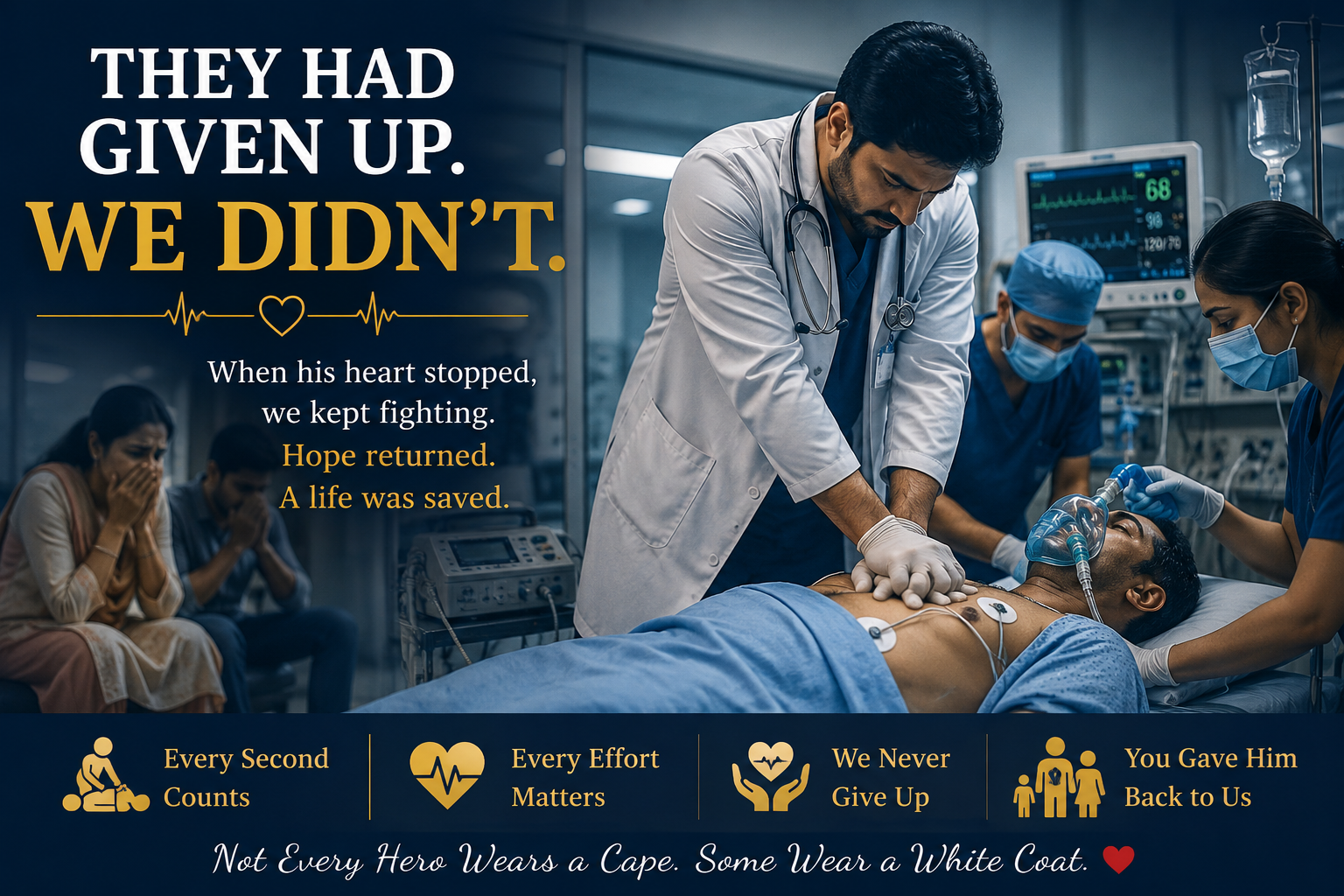
“Don’t Stop, Doctor”: The Heart That Started Beating Again
It was an ordinary evening in the emergency department.
Doctors were attending patients, nurses were moving between beds, and worried families filled the corridor.
Then suddenly, a man was rushed through the emergency doors.
He was in his late fifties.
A few minutes earlier, he had complained of severe chest pain and sweating. On the way to the hospital, he became increasingly restless.
His wife was beside him.
She held his hand and kept saying,
“Please stay awake. We have reached the hospital.”
The doctor immediately examined him.
His face was pale. His clothes were soaked with sweat. His blood pressure was falling.
Something was terribly wrong.
The medical team moved quickly.
A monitor was attached.
An ECG was obtained.
Oxygen and emergency treatment were started.
The doctor looked at the ECG and realised that the patient was suffering from a serious heart attack.
But before much could be said—
the patient suddenly became unconscious.
The Heart Stopped
The monitor changed.
There was no effective pulse.
The patient's heart had stopped.
For a moment, the world outside that bed seemed to disappear.
“Start CPR.”
Chest compressions began immediately.
Emergency medicines were prepared.
The airway was secured.
The defibrillator was brought beside the bed.
Everyone knew that every passing second mattered.
Outside the emergency room, the patient's wife could see people rushing around her husband.
She understood only one thing:
Something terrible had happened.
“Doctor, what happened to him?”
A member of the team gently asked her to wait outside.
The doors closed.
And behind those doors began a battle she could neither see nor control.
“Please Save Him”
The family gathered in the corridor.
His wife was crying.
His son had arrived and stood beside his mother, trying to remain strong.
A few minutes earlier they had been speaking to him.
Now machines, medicines and strangers were fighting to keep him alive.
His wife folded her hands.
“Please save him, Doctor.”
There are moments when a doctor has no reassuring words to give.
There is only work to do.
CPR continued.
The rhythm was checked.
A shock was delivered when indicated.
Then another cycle of compressions.
Medicines.
Another rhythm check.
Everyone watched the monitor.
Still no stable heartbeat.
Minutes passed.
To the family outside, those minutes felt like hours.
When Hope Began to Fade
The doctor knew the situation was critical.
Prolonged cardiac arrest can leave only a narrow path back to life.
But there was still a potentially reversible cause.
There was still a reason to continue.
“Keep going.”
The team continued CPR.
One person performed chest compressions until exhausted and another immediately took over.
The doctor repeatedly reassessed the rhythm.
Another shock.
Another medicine.
Another cycle.
Nobody in that room was thinking about the time.
Nobody was thinking about dinner, sleep or going home.
There was only one thought:
Give him another chance.
Outside, his wife was slowly losing hope.
She sat down against the wall.
Her son held her shoulders.
Through her tears she whispered,
“I think he has left us.”
She began remembering ordinary things.
The cup of tea they had shared that morning.
The small argument they had the previous evening.
The medicines he always forgot to take.
The promise that they would visit their daughter the following month.
Suddenly those ordinary moments seemed more precious than anything in the world.
She cried quietly.
Her son had no words left to comfort her.
They had started preparing themselves for the sentence they feared most:
“We are sorry.”
Then Something Changed
Inside the emergency room, the doctor looked at the monitor again.
A rhythm appeared.
“Check the pulse.”
For a few seconds, nobody spoke.
The doctor placed his fingers over the artery.
There it was.
Faint.
But unmistakable.
A pulse.
“Pulse present.”
Those two words changed the atmosphere in the room.
The patient's heart was beating again.
But the battle was far from over.
His blood pressure remained dangerously low.
He was still unconscious.
He needed intensive monitoring and further treatment for the heart attack.
The doctor stabilised him as much as possible and arranged the next stage of care.
Nobody celebrated yet.
A heartbeat had returned.
Now they had to protect the life that came with it.
“His Heart Is Beating Again”
The doctor finally walked toward the family.
The patient's wife stood immediately.
She searched the doctor's face before he could speak.
“Doctor...?”
“His heart had stopped,” the doctor said gently.
Her face collapsed.
But he continued.
“We performed CPR and resuscitation.”
There was a brief pause.
“His heartbeat has come back.”
For a moment, she simply stared at him.
Perhaps she was afraid she had misunderstood.
“Doctor... he is alive?”
“Yes. He is alive. But he is still very critical, and the next several hours are important.”
She covered her face and began crying.
But these tears were different.
Her son turned away, trying unsuccessfully to hide his own tears.
Only minutes earlier, they had been preparing themselves to lose him.
Now there was hope again.
The Longest Night
The patient was shifted for intensive care.
His family remained outside.
Every time someone came through the door, they looked up.
Every update mattered.
Blood pressure improving.
Heart rhythm stable.
Oxygenation maintained.
Treatment continuing.
The doctor never promised that everything would be fine.
Medicine cannot make such promises.
He simply told them the truth:
“We have crossed one major hurdle. Now we wait and watch.”
That night, the patient's wife hardly slept.
Neither did the medical team caring for him.
Then Came the Moment Everyone Was Waiting For
Hours later, the patient's condition began to stabilise.
And eventually, something happened that his family had been desperately waiting for.
He began to respond.
First, a small movement.
Then he opened his eyes.
The nurse called the doctor.
The doctor came to the bedside and spoke to him.
The patient looked confused.
He did not know how close he had come to never opening his eyes again.
But he was awake.
When his wife was finally allowed to see him, she walked slowly toward the bed.
He looked at her.
She took his hand.
For several seconds, neither of them spoke.
They simply cried.
Sometimes gratitude is too large for words.
“You Gave Him Back to Us”
Over the following days, he continued to improve.
The man who had entered the hospital with a failing heart was now sitting up.
Then eating.
Then speaking with his family.
Eventually, the day came when he was ready to leave the hospital.
His wife had one final thing to do.
Before leaving, she found the doctor.
She folded her hands.
“Doctor, that night we had given up.”
Her voice trembled.
“We thought he was gone.”
The doctor quietly replied,
“We only did what we were supposed to do.”
She shook her head.
“No, Doctor.”
She looked toward her husband.
Then back at him.
“You did not give up when we had already lost hope.”
There were tears in her eyes.
“We will remember that for the rest of our lives.”
The doctor smiled.
There was nothing more that needed to be said.
The Victories Nobody Sees
The family eventually returned to ordinary life.
There would again be morning tea.
Small arguments.
Family gatherings.
Birthdays.
Festivals.
Phone calls.
Perhaps grandchildren climbing onto his lap.
Thousands of ordinary moments that almost disappeared forever on one evening inside an emergency room.
For the doctor, another patient soon occupied that same bed.
Another emergency arrived.
Another family needed help.
The hospital continued as hospitals always do.
But somewhere outside those walls, a family remained complete because, on one difficult night, a medical team continued fighting when a heart had stopped beating.
This is one of the quiet truths of medicine.
Doctors cannot save everyone.
Sometimes, despite everything, they lose the battle.
Those losses stay with them.
But sometimes—
after the compressions,
after the medicines,
after the shocks,
after everyone outside has begun preparing for goodbye—
the monitor shows a heartbeat again.
And a family receives another chance to say:
“Welcome home.”
A Heartbeat Is More Than a Number on a Monitor
To a doctor, the return of a pulse means successful resuscitation.
To a family, it means something much bigger.
It means a husband coming home.
A father speaking again.
A chair at the dining table that will not remain empty.
Another birthday.
Another festival.
Another morning together.
That is why doctors keep trying.
Not because they believe they can defeat death every time.
They know they cannot.
They keep trying because sometimes one more attempt is the attempt that brings someone back.
And somewhere, even years later, a family may still remember the doctor who stood beside their loved one when his heart stopped.
They may forget the names of the medicines.
They may forget the numbers on the monitor.
They may forget exactly how many minutes passed.
But they will never forget the moment someone walked through those emergency-room doors and told them:
“His heart is beating again.”
And perhaps that is one of the greatest privileges of being a doctor—
to stand between despair and hope, to fight when there is still something worth fighting for, and sometimes, to help give a family their loved one back.