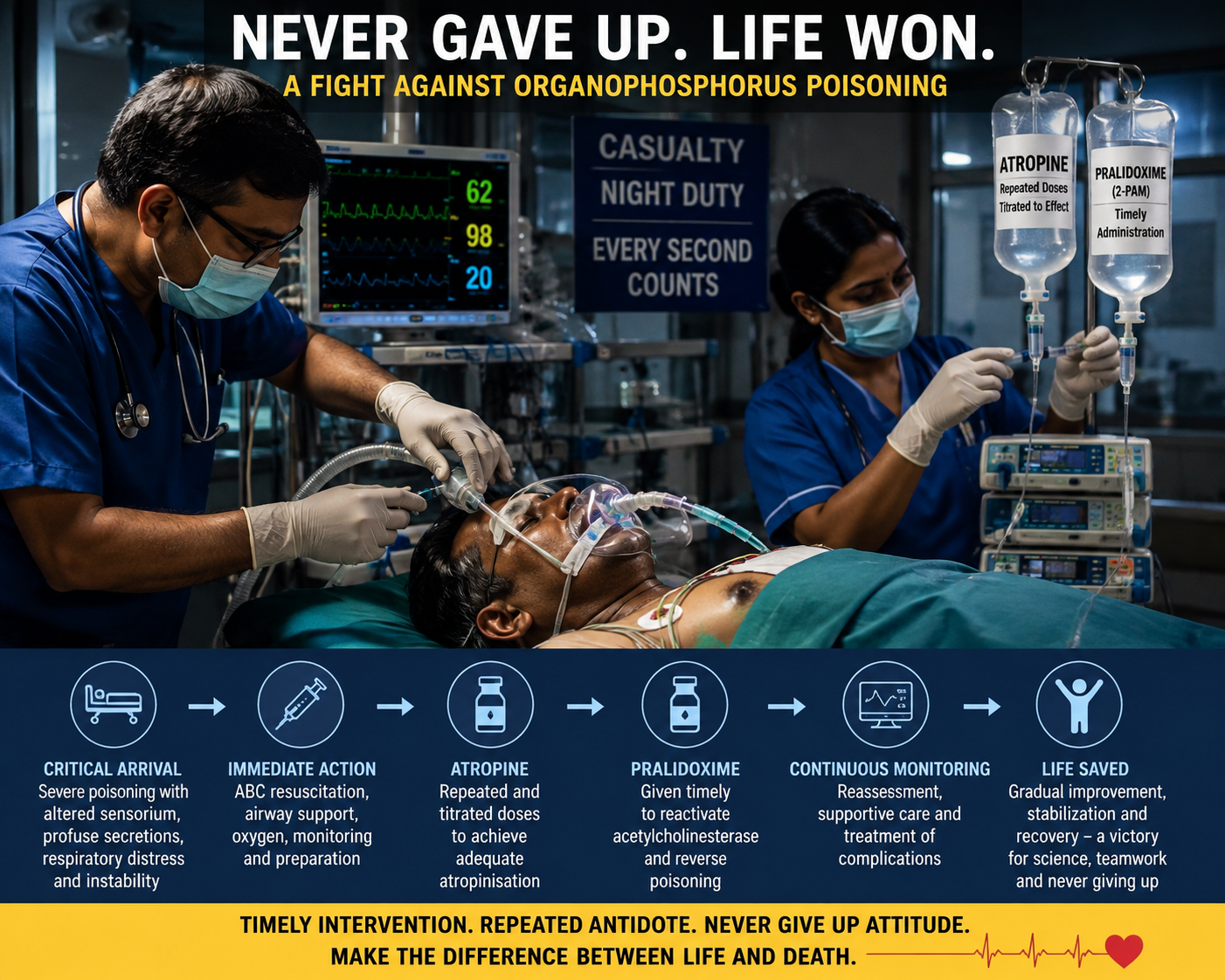
A Night in the Casualty
Night duty in a Medical College casualty can change within seconds.
One moment, the department may seem relatively settled.
The next, a critically ill patient arrives and suddenly every minute matters.
It was during one such night duty that a patient was rushed into our casualty following suspected organophosphorus poisoning.
By the time the patient reached us, the condition was extremely critical.
The patient had altered sensorium, profuse oral and respiratory secretions, excessive sweating, pinpoint pupils and significant respiratory difficulty. The vital parameters were unstable.
This was not a situation where we could wait for every investigation before beginning treatment.
The clinical picture was speaking loudly enough.
Severe organophosphorus poisoning with a life-threatening cholinergic crisis.
And the first priority was simple:
Keep the patient alive.
---
The Battle Began Immediately
Resuscitation was initiated without delay.
Airway, breathing and circulation were assessed and supported. Oxygen was administered, intravenous access was secured, monitoring was started and preparations were made for advanced airway support should the patient's respiratory status deteriorate further.
But in organophosphorus poisoning, supportive treatment alone is not enough.
The excessive cholinergic activity had to be reversed.
Atropine was started immediately.
In severe poisoning, atropine cannot be approached as a small, fixed-dose medication given at comfortable intervals. The dose has to be repeated and rapidly escalated according to the patient's clinical response until adequate atropinisation is achieved.
The patient continued to have significant secretions and respiratory compromise.
So atropine was repeated.
The response was reassessed.
Secretions persisted.
Atropine was given again.
And again.
The treatment was guided not simply by the number of ampoules administered, but by the patient in front of us — particularly clearing of bronchial secretions, improvement in air entry, oxygenation, haemodynamics and other clinical evidence of adequate atropinisation.
---
Atropine Was Only One Part of the Fight
Alongside atropine, Pralidoxime (2-PAM) was administered as an oxime therapy.
Organophosphorus compounds inhibit acetylcholinesterase, resulting in accumulation of acetylcholine at cholinergic synapses. Atropine antagonises the dangerous muscarinic effects of this excess acetylcholine, while pralidoxime can help reactivate inhibited acetylcholinesterase before irreversible “ageing” of the enzyme occurs, particularly helping with nicotinic manifestations such as muscle weakness.
In a severely poisoned patient, therefore, treatment is not about choosing between atropine and pralidoxime.
It is about early resuscitation, adequate atropinisation, appropriate oxime therapy, respiratory support and meticulous monitoring working together.
---
There Were Moments When Improvement Seemed Far Away
This is perhaps the most difficult part of managing a critically ill poisoned patient.
You administer the antidote.
You reassess.
And the patient is still critical.
Another dose.
Another reassessment.
Still excessive secretions.
Still respiratory difficulty.
Still unstable.
During such moments, it is easy for everyone around the patient to become anxious. Family members are frightened. The casualty team is working continuously. The clock keeps moving.
But severe organophosphorus poisoning may require large cumulative doses of atropine, and inadequate atropinisation can be dangerous.
So we continued.
Treatment was escalated according to the clinical response.
The airway and respiratory status were watched closely.
Pralidoxime therapy was continued as indicated.
The patient was repeatedly reassessed for secretions, chest findings, oxygenation, pulse, blood pressure, neurological status and signs of complications.
There was no dramatic miracle.
There was instead something much more characteristic of emergency medicine:
small improvements appearing one after another.
---
Then the Patient Began to Turn the Corner
Gradually, the respiratory secretions decreased.
Air entry improved.
Oxygenation became better.
The haemodynamic parameters began to stabilise.
The clinical picture that had looked frightening only hours earlier started moving in the opposite direction.
For the treating team, these are extraordinary moments.
A monitor may show only numbers.
But when those numbers begin to stabilise in a patient whom you have been fighting to save for hours, they mean much more.
They mean that the treatment is working.
They mean that the body is fighting back.
And most importantly,
they mean there is hope.
The patient was subsequently shifted for continued close monitoring and further management. Recovery from severe organophosphorus poisoning does not end with initial atropinisation; patients must be watched carefully for recurrent cholinergic manifestations, respiratory muscle weakness, aspiration, arrhythmias, intermediate syndrome and other complications.
But the immediate battle had been won.
The patient had survived the most critical phase.
---
What That Night Taught Me
Medicine is built on science.
Knowing the mechanism of poisoning matters.
Knowing when and how to use atropine matters.
Knowing the role and limitations of pralidoxime matters.
Recognising respiratory failure early matters.
But emergencies also demand something that cannot be written completely into a prescription:
persistence.
A critically ill patient does not always improve after the first intervention.
Sometimes you have to reassess.
Escalate.
Correct.
Repeat.
Watch.
And continue.
That night reminded me why I strongly believe in a simple principle:
«Never give up merely because the patient looks critically ill. If a reversible cause exists and evidence-based treatment can still make a difference, keep fighting for the patient.»
---
The Bigger Lesson: Organophosphorus Poisoning Is Treatable
Organophosphorus poisoning remains a medical emergency, but severe poisoning is not synonymous with inevitable death.
Early recognition and timely hospital treatment can save lives.
The essential principles are:
- Immediate ABC resuscitation and decontamination when appropriate and safe
- Early, adequately titrated atropine therapy
- Pralidoxime when clinically indicated, particularly when given appropriately in significant poisoning
- Early recognition and management of respiratory failure
- Continuous clinical reassessment rather than relying on a fixed atropine dose
- Close monitoring for intermediate syndrome and other delayed complications
- Appropriate critical-care support
- Psychiatric/psychosocial assessment after recovery when the poisoning was intentional
One particularly important lesson is that atropine should be titrated to clinical endpoints, especially control of bronchial secretions and improvement in respiratory status—not merely to pupil size or tachycardia.
---
A Life Saved Is More Than a Successful Treatment
When we work in a casualty, we rarely know what kind of emergency will come through the door next.
Some patients arrive walking.
Some arrive unconscious.
Some arrive at a point where the difference between life and death may depend on decisions made during the next few minutes.
That night, a critically ill patient with organophosphorus poisoning arrived at our Medical College casualty.
There was no guarantee of recovery.
There was only a patient who needed help, an emergency that demanded immediate action, and a treatment that had to be pursued aggressively and carefully.
We treated.
We reassessed.
We repeated the antidote when required.
We supported the patient through the critical period.
And we did not give up.
Eventually, the patient survived.
For me, that remains one of the most meaningful rewards of clinical medicine.
Not the number of injections given.
Not the hours spent awake.
Not even the complexity of the case.
It is that somewhere, because a medical team acted at the right time and continued fighting when the situation looked difficult, a person was given another chance at life.
Never Give Up While There Is Still Something You Can Do.
This article is based on a clinical experience and is intended for medical education and public awareness. Patient-identifying details have been omitted. Management of organophosphorus poisoning should be individualised according to clinical severity, local protocols and available critical-care resources.