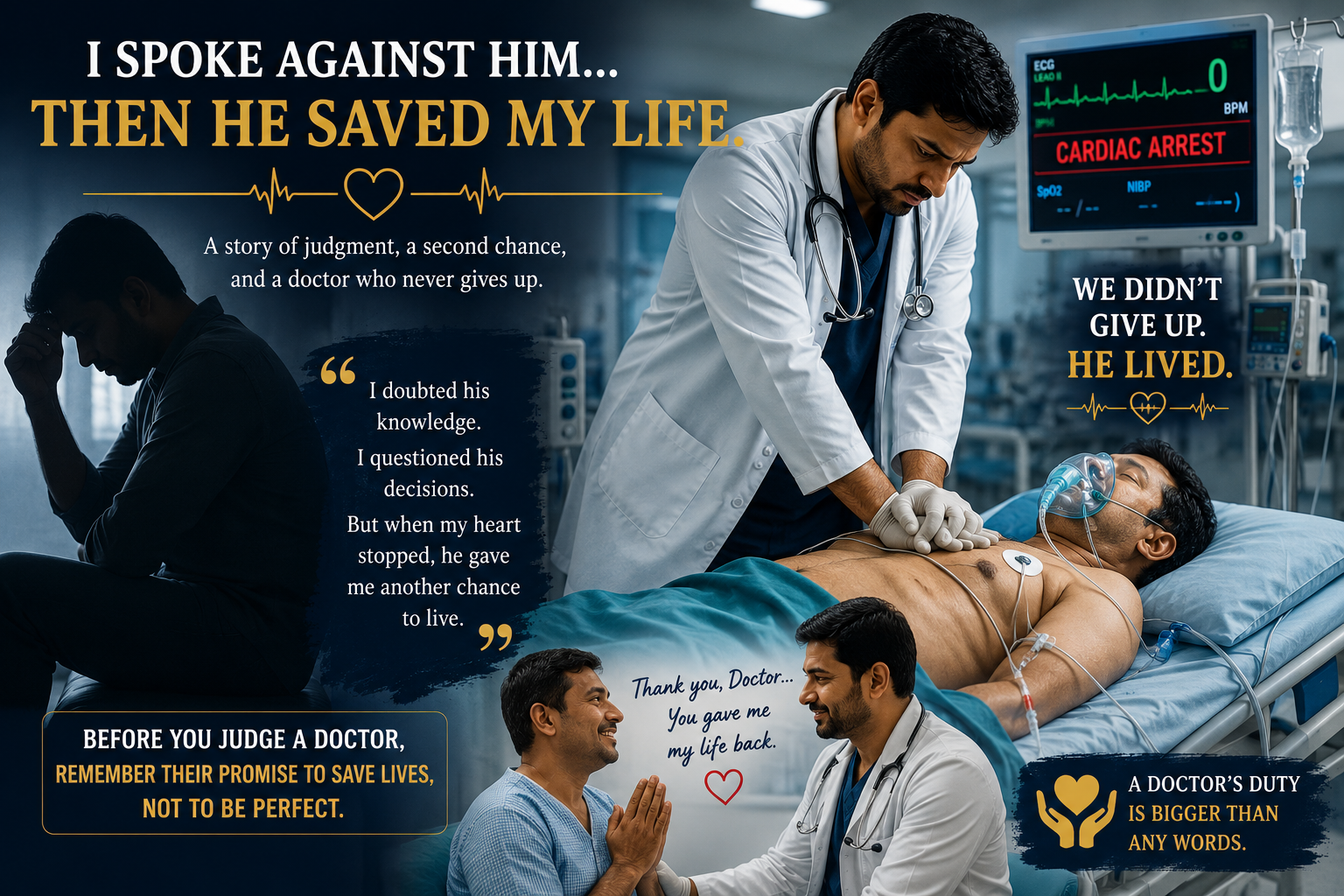
The Doctor I Once Spoke Against Became the Doctor Who Saved My Life
There was a time when I did not like that doctor.
To be truthful, I barely knew him.
I had never sat with him for a meaningful conversation. I had never seen him managing a critically ill patient. I did not know how many nights he had spent in the hospital or how many difficult decisions he had made.
But I had opinions about him.
And I shared them freely.
“He is not as good as people think.”
“I don't trust his treatment.”
“There are much better doctors.”
Sometimes I questioned his knowledge.
Sometimes I questioned his decisions.
And sometimes, without having enough facts, I questioned his credibility.
People listened.
A few agreed.
Others repeated what I had said.
Slowly, my opinion became somebody else's opinion too.
I never stopped to think about what my words could do to another person's reputation.
After all, they were only words.
At least, that was what I believed.
Until one night, when I desperately needed the very doctor I had spoken against.
The Night Everything Changed
It began with a strange heaviness in my chest.
I initially ignored it.
“Probably gas,” I told my wife.
But within minutes, the discomfort became severe.
The pain spread toward my arm.
Sweat covered my forehead.
I felt nauseated.
Then came a terrible feeling that is difficult to describe unless you have experienced it yourself—
the feeling that something was seriously wrong.
My wife looked at my face and became frightened.
“We are going to the hospital.”
I wanted to argue.
I couldn't.
By the time we reached the emergency department, I was struggling even to sit properly.
My family rushed inside asking for help.
A nurse brought a wheelchair.
An ECG was arranged immediately.
And then I heard a familiar voice.
“Bring him here.”
I looked up.
For a moment, even through the pain, my heart sank.
It was him.
The doctor I had criticised.
The doctor whose knowledge I had questioned.
The doctor about whom I had told others:
“I wouldn't trust him with a serious patient.”
And now I was the serious patient.
Our Eyes Met
He recognised me.
I could see it.
For perhaps one second, our eyes met.
I remembered everything I had said about him.
I wondered whether he remembered too.
I felt ashamed.
But the doctor did not ask me why I had spoken against him.
He did not remind me of anything.
He did not walk away.
He simply turned toward the nurse.
“ECG. IV access. Monitor him. Check his blood pressure.”
Then he came closer and examined me.
His voice was calm.
“Where exactly is the pain?”
I pointed toward my chest.
He studied the ECG.
His expression changed.
He looked at me and then at my family.
“This is a heart attack. We need to act quickly.”
Suddenly, everything else became meaningless.
My pride.
My opinions.
My previous words.
All I wanted was to live.
The Man I Had Criticised Was Now Fighting for Me
My condition was serious.
The doctor explained the situation to my family and immediately started appropriate emergency treatment.
I was shifted to intensive monitoring.
My heart rhythm was watched continuously.
My blood pressure was repeatedly checked.
Medicines were administered.
Blood investigations were sent.
Every few minutes someone was beside me.
The doctor kept returning.
He looked at the monitor.
He looked at the ECG.
He reassessed my chest pain.
He spoke to the nursing staff.
He coordinated further cardiac care.
There was no anger in his voice.
No revenge.
No indifference.
Only urgency.
The same person whose professional ability I had casually questioned was now using that very knowledge to keep me alive.
Time Was Muscle
The ECG showed an acute myocardial infarction—a major heart attack in which restoring blood flow quickly could mean the difference between surviving and losing a large part of the heart muscle.
There was no time for personal history.
There was no time for ego.
There was only a patient who needed treatment.
The doctor discussed the available reperfusion strategy with the family.
Given the clinical situation and immediate circumstances, thrombolytic treatment was initiated while arrangements were made for definitive cardiac evaluation and further intervention.
I remember very little from those hours.
But my wife remembers everything.
She remembers the doctor repeatedly checking me.
She remembers him explaining what was happening.
She remembers asking him,
“Doctor, will he survive?”
And she remembers his answer.
“We are doing everything possible. Right now, we must not lose time.”
Eventually, I was transferred for coronary angiography and PCI.
A significantly blocked coronary artery was identified and treated.
Blood began flowing through the artery again.
The heart that had been starved of oxygen was given another chance.
And so was I.
The Morning I Never Thought I Would See
When I opened my eyes properly later, I saw my wife sitting nearby.
Her eyes were swollen from crying.
For a few seconds, I did not understand where I was.
Then everything slowly returned.
The chest pain.
The hospital.
The ECG.
The doctor's face.
I whispered,
“What happened?”
My wife held my hand.
“You had a major heart attack.”
I looked at her.
She began crying.
Then she said something I will remember for the rest of my life.
“That doctor saved you.”
I knew exactly whom she meant.
I closed my eyes.
Not because I was tired.
Because I was ashamed.
Every Word Came Back to Me
Lying in that hospital bed, I remembered the conversations I had once enjoyed having.
“He doesn't know enough.”
“I don't think he is a good doctor.”
“Don't go to him.”
I had spoken with such confidence.
But what did I actually know?
Had I studied medicine?
Had I spent years learning how to recognise a heart attack from an ECG?
Had I stood beside critically ill patients at two in the morning?
Had I ever carried the responsibility of deciding what to do when another human being's life depended on the next few minutes?
No.
Yet I had judged someone who did.
And when my own life depended upon him, he did not judge me back.
That hurt more than any argument could have.
Then the Doctor Came to See Me
Later, he entered the room during his round.
He looked at the monitor and reviewed my reports.
“How are you feeling?”
“Better, Doctor.”
He checked me, discussed my medicines and explained what I would need to do after discharge.
I kept looking at him.
Finally, I said,
“Doctor, can I tell you something?”
He looked at me.
My throat tightened.
“I don't know whether you know this... but I have spoken badly about you.”
He remained silent.
“I questioned your knowledge. I told people not to trust you.”
My eyes filled with tears.
“I am sorry.”
There are apologies that come from politeness.
And there are apologies that come after life has broken someone's pride.
Mine was the second kind.
I continued,
“You knew who I was. You could have been angry with me.”
He interrupted gently.
“You came to me as a patient. That was all that mattered.”
I could not answer.
Those words destroyed the last defence of my ego.
I turned my face away and cried.
“You Could Have Treated Me Differently”
When I had composed myself, I said,
“You could have treated me differently after everything I said.”
The doctor smiled faintly.
“A doctor's duty doesn't change according to whether a patient likes him or dislikes him.”
He paused.
“When somebody comes to us sick, our responsibility is to treat that person with the best judgment and knowledge we have.”
There was no lecture.
No demand for an apology.
No attempt to make me feel smaller.
Perhaps that made the lesson even more powerful.
The Day I Walked Out
Eventually, I became stable enough to leave the hospital.
The day of discharge should have been a happy day.
And it was.
But before leaving, there was one person I needed to meet.
My wife and I found the doctor.
This time, I did something I had never imagined doing.
I folded my hands in front of him.
“Thank you.”
He immediately told me there was no need.
But there was.
“Doctor, you did more than treat my heart.”
He looked at me quietly.
“You changed something here.”
I touched my chest.
And then my head.
“I had judged you without understanding you. I had spoken about your profession without knowing what it means to carry someone's life in your hands.”
My wife was crying beside me.
I said,
“I cannot take back every word I said. But I can decide what I say from today onward.”
The Promise
I made him a promise that day.
I would never blindly defame a doctor again.
That does not mean doctors should never be questioned.
Doctors are human. They can make mistakes. Patients deserve explanations, transparency and accountability when something genuinely goes wrong.
But criticism should come from facts—not rumours, incomplete information or personal dislike.
I had learned that difference in the most frightening way possible.
So I promised something else.
Whenever I heard someone casually destroying a doctor's reputation without knowing the full story, I would tell them mine.
I would say:
“Be careful with your words. One day, the person you are criticising may be the person standing between you and death.”
What I Understand Now
Before my heart attack, I saw doctors from the outside.
A prescription.
A consultation fee.
A few minutes beside a hospital bed.
A decision I sometimes did not understand.
After my heart attack, I saw something different.
I saw responsibility.
I saw decisions being made while every minute mattered.
I saw people working while a frightened family waited outside.
I saw a doctor treating a man who had once spoken against him without allowing personal feelings to interfere with professional duty.
Most importantly, I understood something I should have understood long before:
A doctor's decision may not always produce the outcome we want, but most doctors enter that room with one intention—to help the patient in front of them.
Medicine is not magic.
Doctors cannot guarantee that every treatment will work.
They cannot save every patient.
They cannot know everything.
And they should certainly be accountable when genuine negligence occurs.
But disagreement with a doctor's decision is not automatically proof of incompetence.
A complication is not automatically negligence.
And a poor outcome does not automatically mean that nobody tried.
I Still Carry the Scar
Today, I carry a small reminder of that night.
A treated coronary artery.
A handful of medicines every morning.
Regular follow-ups.
And a memory that will never leave me.
Sometimes when I see my family sitting together, I think about how easily my chair could have been empty.
I think about my wife returning home without me.
I think about my children receiving a phone call telling them their father was gone.
And then I remember the emergency room.
The monitor.
The urgency.
And the doctor I once said I would never trust.
He was there when I needed someone to trust the most.
If You Ever Hear Me Defending a Doctor
Now, when someone begins criticising a doctor casually, I do not immediately join the conversation.
I ask:
“Do you know the whole story?”
“Do you know what condition the patient was in?”
“Do you know what decisions had to be made?”
“Do you know what was happening inside that emergency room?”
Because once, I did not ask those questions.
I simply spoke.
And words can injure a reputation that took decades to build.
I cannot erase what I said in the past.
But perhaps I can prevent somebody else from making the same mistake.
The Man I Tried to Bring Down Helped Me Stand Again
There is an irony in my story that I will carry for the rest of my life.
I once tried to make people doubt that doctor.
Then one night, my own heart began to fail.
And when I was brought helplessly through the doors of his hospital, he did not see an enemy.
He did not see a critic.
He did not see the man who had spoken behind his back.
He saw a patient.
And he did what doctors are trained to do.
He treated me.
He monitored me.
He made difficult decisions.
He helped arrange the treatment my heart urgently needed.
And when I finally walked out of the hospital alive, I understood the weight of something I had once taken too lightly:
the responsibility of wearing a white coat.
I had once used my words to question his credibility.
He answered me without an argument.
He answered with his duty.
And today, whenever somebody asks me what kind of doctor he is, I no longer repeat rumours.
I simply tell them:
“When my life was in his hands, he never allowed my words against him to change his duty toward me.”
Then I tell them the lesson that nearly cost me my life to learn:
Question when you genuinely need answers. Seek accountability when there is genuine wrongdoing. But never destroy a doctor's name casually without knowing the truth.
Because behind every medical decision is a human being carrying an enormous responsibility.
And sometimes the doctor you judge today may become the doctor you desperately need tomorrow.
I once spoke against him behind his back.
When my heart stopped me in my tracks, he stood beside my bed.
I gave him disrespect.
He gave me care.
And for the second chance at life that followed,
I will remain grateful for the rest of mine.