Between Midnight and Dawn: The Night We Refused to Give Up
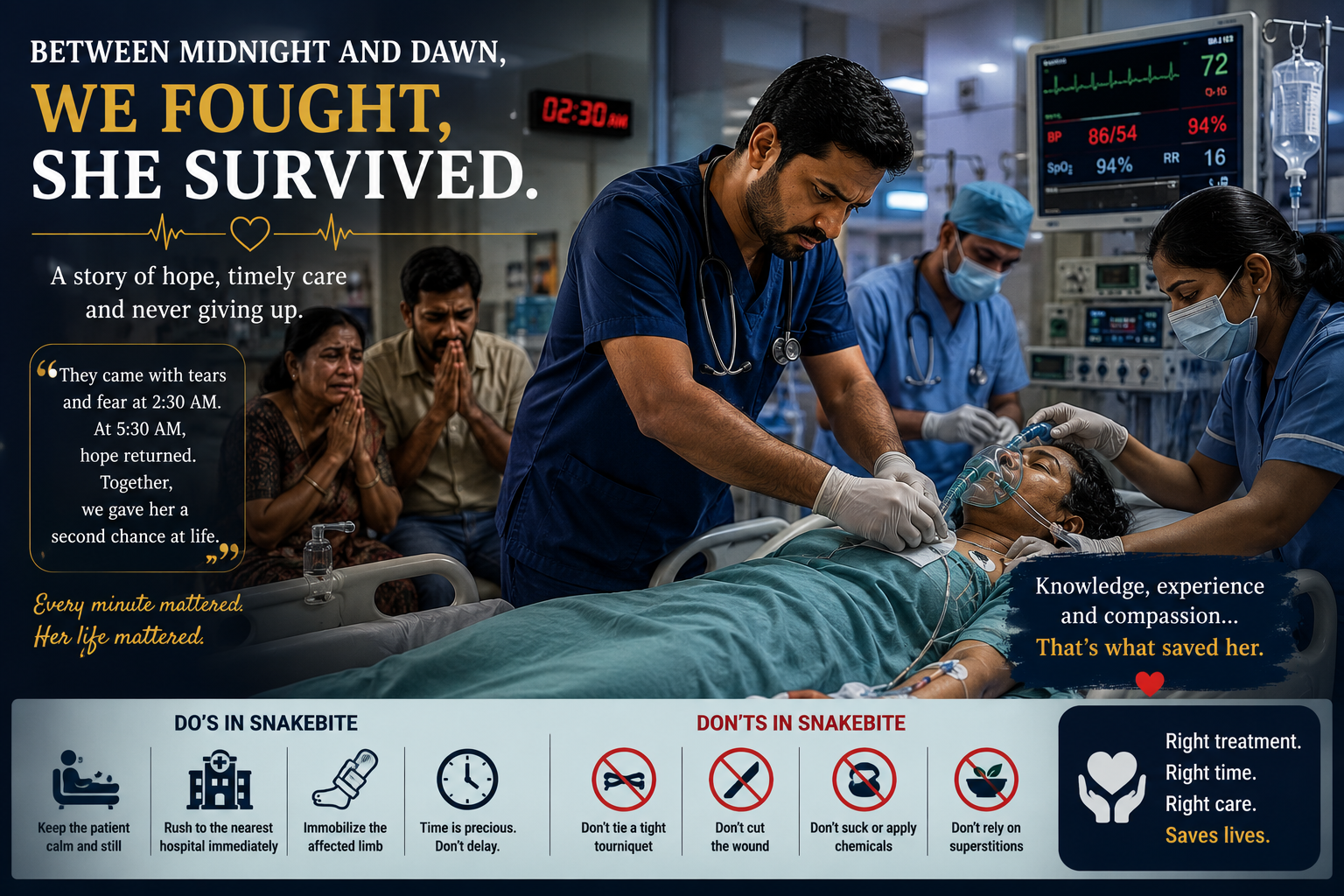
It was around 2:30 in the morning.
The hospital had entered that strange silence of the night when the corridors become quieter, the lights seem dimmer, and every unexpected sound feels louder.
I was on night duty.
Then suddenly, the silence was broken.
A woman was rushed into the emergency room surrounded by frightened relatives.
“She has been bitten by a snake!”
“Doctor, please save her!”
“Please do something!”
Some were crying. Others were speaking all at once.
But the woman lying in front of me could say nothing.
She had altered sensorium, her vital signs were unstable, and there were features suggesting a potentially dangerous envenomation.
There was no time to panic.
There was no time to predict what would happen.
There was only time to act.
The Fight Began at 2:30 AM
We immediately started resuscitation.
IV access was secured.
Fluids and necessary emergency medications were given according to her clinical condition.
Airway, breathing and circulation were assessed repeatedly, and supportive measures were initiated.
Her neurological findings raised concern for a neurotoxic snake envenomation.
That changed the urgency of everything.
A neurotoxic snakebite can progressively weaken the muscles required for breathing. A patient who appears to be breathing at one moment may deteriorate rapidly.
She needed close observation.
She was shifted to the ICU.
Anti-snake venom (ASV) was administered when clinically indicated, with careful monitoring.
And then we waited for a response.
But there was no dramatic improvement.
Her family stood outside the ICU.
Every few minutes someone approached me.
“Doctor, is she improving?”
“Doctor, will she survive?”
“Doctor, please tell us something.”
I understood their anxiety.
For them, someone they loved had walked out of the house and was now lying unconscious inside an ICU.
They wanted certainty.
But medicine does not always give us certainty.
I kept explaining:
“She is critically ill. We are treating her. Please give us some time.”
When Treatment Does Not Produce an Instant Miracle
The hours that followed were difficult.
She was monitored continuously.
Her neurological status, breathing, circulation and other vital parameters were repeatedly reassessed.
Further antivenom was administered as clinically indicated, and in view of the neuroparalytic manifestations, an atropine-neostigmine trial/therapy was used where appropriate.
Still, recovery was not immediate.
That is one of the hardest things for families to understand during an emergency.
They see medicines being given and naturally expect the patient to wake up.
But severe illness does not always respond within minutes.
Sometimes treatment means stabilising a patient while the body slowly begins to recover.
And sometimes all a doctor can do is continue appropriate treatment, watch carefully for deterioration, support failing functions and refuse to abandon hope while there is still a reasonable chance.
“Doctor, Is There Any Hope?”
The night became longer.
The family remained outside.
Some prayed.
Some cried quietly.
Some simply stared toward the ICU door.
Again they asked me:
“Doctor, is there any hope?”
I could not promise them that she would survive.
No responsible doctor should make such a promise in a critically ill patient.
But I could promise them something else:
We were not going to stop trying.
So we continued.
Monitor.
Reassess.
Treat.
Wait.
Reassess again.
In critical care, sometimes perseverance is not dramatic.
It is simply doing the right things repeatedly, hour after hour, while waiting for the patient's body to respond.
Then Dawn Came
It was approaching 5:30 AM.
Outside, darkness was slowly giving way to morning.
Inside the ICU, we noticed something we had been waiting for throughout the night.
A small change.
Then another.
There were signs of clinical improvement.
To someone outside medicine, those early changes might have appeared insignificant.
To us, they meant something enormous.
They meant:
There was hope.
After hours of uncertainty, the direction finally seemed to be changing.
I looked at the patient again.
Then at the monitor.
The numbers were beginning to tell a different story.
I went outside to speak with the family.
They immediately surrounded me.
“How is she, Doctor?”
This time, I could give them something they had been waiting all night to hear.
“She is showing some improvement.”
Their faces changed.
Nobody celebrated loudly.
They were still frightened.
But the despair in their eyes was replaced by something that had been missing for hours.
Hope.
The Battle Wasn't Over
The improvement at dawn was only the beginning.
She remained in the ICU for the next five days.
She required close observation and continued supportive care.
Day by day, she improved.
The fear of that first night gradually became a memory.
Eventually, she became stable enough to leave the ICU and was shifted to the ward.
For a doctor, that journey—from seeing someone critically ill and unconscious in the middle of the night to later seeing the same person awake and recovering—is difficult to describe.
There is no applause inside most hospitals.
There is usually just a quiet sense of relief.
The treatment worked.
The patient fought.
And this time, life won.
The Day She Went Home
Eventually, the day came for discharge.
The woman who had arrived unconscious at 2:30 in the morning was now going home with her family.
Before leaving, her relatives came to meet me.
Their expressions were completely different from the faces I had seen outside the ICU that night.
They thanked me.
Again and again.
But I told them something important:
They had also done something right.
They brought her to the hospital.
And they brought her while there was still time to treat her.
That decision mattered enormously.
Because in snakebite, time can mean life.
“Doctor, We Had Tied the Limb Very Tightly”
During our discussion, another important issue came up.
Like many families frightened by a snakebite, they had believed that tightly tying the affected limb would prevent the venom from spreading.
This is a common and potentially dangerous misconception.
I explained that a tight arterial tourniquet should not be applied after a snakebite.
A very tight ligature can severely reduce blood flow to the limb, worsening local tissue injury and potentially causing serious complications.
Traditional practices, cutting the wound, attempting to suck out venom, applying chemicals or delaying hospital treatment while seeking unproven remedies can waste the most valuable thing a snakebite victim has:
time.
The goal should not be to perform dramatic procedures at home.
The goal should be to get the patient safely to an appropriate healthcare facility as quickly as possible.
What Should You Do After a Suspected Snakebite?
The person should be kept as calm and still as possible.
Movement of the affected limb should be minimised, and unnecessary walking or exertion should be avoided.
Remove rings, bangles, anklets or other tight objects that may become problematic if swelling develops.
Arrange urgent transport to a hospital capable of managing snakebite and its complications.
Do not waste precious time trying to catch or kill the snake.
Do not cut the bite wound.
Do not suck the wound.
Do not apply ice, chemicals, herbal preparations or other substances.
And importantly:
Do not tightly tie the limb with a tourniquet in an attempt to stop the venom.
Snakebite treatment should be guided by the patient's clinical features and appropriate medical protocols.
Superstition Can Cost the Most Precious Hours
Snakebite has always been surrounded by fear.
And where there is fear, superstition often finds space.
Families may first visit a traditional healer.
Someone may attempt rituals.
Someone may advise waiting.
Someone may say that the snake was probably harmless.
Meanwhile, a neurotoxic venom may be silently weakening the patient's respiratory muscles.
The victim may become drowsy.
The eyelids may begin to droop.
Speech and swallowing may become difficult.
Breathing may progressively weaken.
By the time the family realises how serious the situation is, valuable hours may have been lost.
Faith and cultural beliefs are deeply personal.
But when a person has a suspected venomous snakebite, medical treatment must not be delayed.
Prayer can accompany the journey to the hospital.
It should never replace that journey.
The Most Important Medicine That Night Was Also Time
People sometimes remember the antivenom.
They remember injections.
They remember the ICU.
They remember the monitors.
But there was another crucial factor in this woman's survival:
She reached medical care while there was still an opportunity to intervene.
Imagine if the family had waited several more hours.
Imagine if they had relied only on a tightly tied tourniquet.
Imagine if progressive paralysis had severely compromised her breathing before reaching medical help.
The story might have ended very differently.
That is why one of the most important lessons from this night has nothing to do with a particular medicine.
It is simply this:
Do not waste time after a suspected snakebite.
What That Night Reminded Me About Being a Doctor
By the time morning arrived, I was exhausted.
But seeing the first signs of improvement made those hours worthwhile.
That night reminded me why emergency medicine can be both frightening and deeply meaningful.
At 2:30 AM, a family entered the hospital crying and begging us to save someone they loved.
At 5:30 AM, there was finally a ray of hope.
Five days later, she left the ICU.
And eventually, she walked out of the hospital.
As doctors, we cannot promise that every critically ill patient will survive.
Sometimes, despite everything we do, we lose the battle.
But while there is a reasonable chance to help, we continue.
We reassess.
We treat.
We support.
We wait.
And sometimes, after a long night when everyone fears the worst, the first light of morning brings more than sunrise.
It brings hope.
Take-Home Message
Snakebite is a medical emergency—not a situation for experimentation, superstition or delay.
If a snakebite is suspected:
- Keep the patient calm and minimise unnecessary movement.
- Seek appropriate medical care urgently.
- Do not cut or suck the wound.
- Do not apply chemicals or unproven remedies.
- Do not apply a tight arterial tourniquet.
- Do not delay hospital treatment while seeking traditional remedies.
- Watch for danger signs such as drooping eyelids, difficulty speaking or swallowing, weakness, breathing difficulty, bleeding, persistent vomiting, collapse or altered consciousness.
Every minute matters.
Lesson From This Story
That night taught all of us something.
The family learned that reaching the hospital quickly can save a life.
They learned that superstition and harmful first-aid practices can steal precious treatment time.
And for me, it reinforced something medicine teaches us repeatedly:
Never abandon hope too early—but never replace sound medical judgment with hope alone.
Treat what can be treated.
Support what can be supported.
Explain honestly to the family.
Keep reassessing.
And continue doing the right thing while there is a meaningful chance of recovery.
At 2:30 AM, she arrived unconscious and critically ill.
At 5:30 AM, we saw the first ray of hope.
Five days later, she left the ICU.
And eventually, she went home to the people who had once stood outside its doors crying and begging for her life.
Sometimes the difference between tragedy and a second chance is not a miracle.
It is recognising the emergency, reaching the hospital in time, receiving the right treatment—and refusing to waste the precious minutes in between.